Motion Capture Setup: OptiTrack
This section provides helpful information on motion capture system setup.
Quick Start Resources
This section references the OptiTrack Gitbook and sections out quick start material to allow the reader a guide to efficiently install and use OptiTrack motion capture system. A video format is provided in the following:
Preparing the motion capture volume requires a variety of checkpoints that must be followed to ensure a successful configuration, these can be found:
Preparing Capture Area
With an ideal motion capture area, a quick guide on the placement and aiming of camera can be found:
Camera Mounting, Aiming and Placement
By Example with 4 Camera Setup
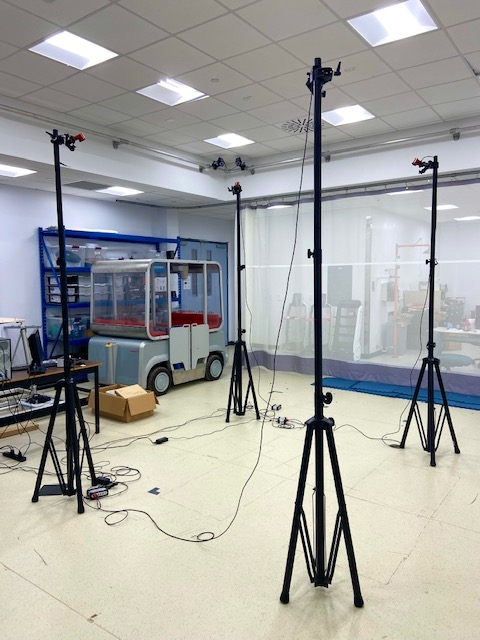
A simplified process to my hardware configuration in the lab is provided with brief descriptions on my 4 camera Optitrack motion capture system configuration. The steps are as follows:
Mount the Flex-13 cameras onto the provided tripods, elevate the cameras 7 slots up and make sure the center view of each camera corresponds to the center ground position within the volume. I used the L-shape tool and motive software to ensure the camera were orientated correctly.
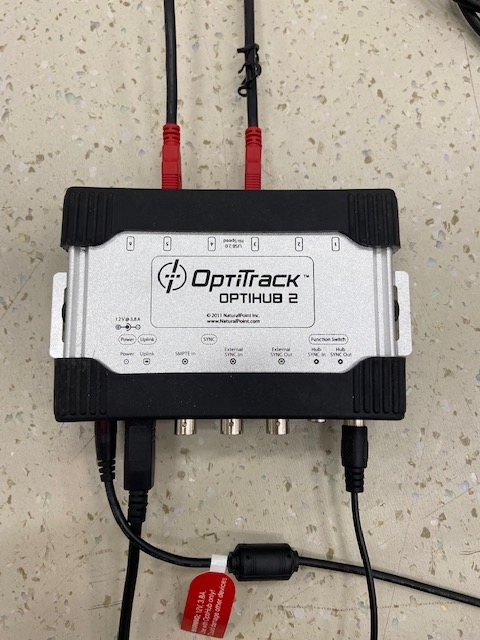
Use two different OptiTrack hubs and plug two cameras into one hub (usb ports) and two cameras into the other hub.
Connect the power ports of the hubs into a power bar with appropriate wires.
Plug the usb type B into the port next to the power port (uplink port) and then connect to the usb port into the computer. Do this for each hub.
Connect both hubs by connecting the hub sync-in port from one hub to the hub sync-out port of the other hub.
Once all the hardware is connected, the next step is camera setup and calibration within the motive software.
Last updated